

Best practices for centrifuge operation include verifying the rotor is free of damage and ensuring the chamber is clean before use. Samples should be evenly balanced and securely contained to prevent spills. Operators must select speed and time settings based on sample type to avoid degradation. Routine cleaning and inspection prevent residue buildup and equipment wear ultracentrifuge. Troubleshooting starts with checking load balance and connections, escalating to professional service if needed. Further insights explain how to optimize centrifuge performance and maintenance.

How to Prepare Your Centrifuge for Safe and Accurate Operation
Before operating the centrifuge, it is essential to verify that all components are clean, properly assembled, and free of damage. This careful inspection helps assure reliable performance and personal safety.
The rotor should be checked for cracks or corrosion https://laballiance.com.my/, and the chamber must be free of debris. Confirm that the lid locks securely and that the balance system functions correctly to prevent vibrations during use.
Proper electrical connections and grounding are also critical to avoid malfunctions. Calibration of speed and timer settings should be verified against manufacturer guidelines to guarantee accurate results.
Tips for Loading Samples to Avoid Damage and Contamination
When loading samples into a centrifuge, careful attention to balance and proper placement is essential to prevent equipment damage and sample contamination.
Samples should be evenly distributed, with tubes of equal weight placed opposite each other to maintain rotor stability.
Avoid overfilling tubes to prevent spillage, which can lead to cross-contamination.
Use compatible, sealed containers to contain aerosols and reduce exposure risks.
Inspect tubes for cracks or defects prior to loading, ensuring integrity under centrifugal force.
Employ clean gloves and sterile techniques to handle samples, minimizing contamination.
Secure lids firmly and confirm correct orientation within the rotor.
Following these guidelines supports safe, efficient centrifuge operation while protecting sample integrity and equipment longevity.
Setting the Right Speed and Time for Different Applications
Proper sample loading lays the foundation for effective centrifugation, but achieving peak results also depends on selecting the appropriate speed and duration for each specific application. Different samples require tailored centrifuge settings to guarantee peak separation without compromising sample integrity.
For instance, low-speed settings suit delicate cells, while high speeds effectively pellet smaller particles like proteins or nucleic acids. Time must also be calibrated carefully; excessive duration can lead to overheating or sample degradation, whereas insufficient time might result in incomplete separation.
Operators benefit from consulting manufacturer guidelines and empirical data to determine ideal parameters. By balancing speed and time thoughtfully, users maintain sample quality, maximize efficiency, and preserve equipment functionality, ultimately granting freedom to adapt protocols confidently across diverse experimental needs.
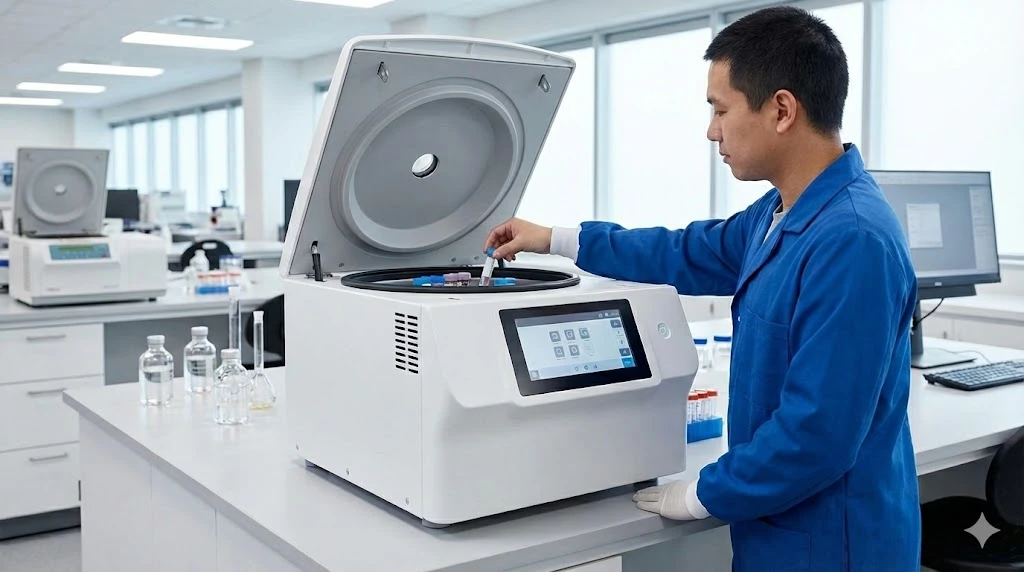
Routine Cleaning and Inspection to Extend Centrifuge Life
Regular cleaning and inspection are essential practices to maintain centrifuge performance and extend its operational lifespan.
Routine cleaning prevents residue buildup that can impair balance and efficiency. Using appropriate cleaning agents and following manufacturer guidelines helps avoid damage to delicate components.
Inspections should focus on wear signs, such as cracks or corrosion on rotors and buckets, ensuring safe operation. Checking seals and lubricating moving parts minimizes friction and reduces mechanical failure risk.
Documenting maintenance activities supports tracking and timely interventions. By committing to consistent cleaning and inspection, users preserve centrifuge reliability and avoid unexpected downtime.
This proactive approach empowers operators to maintain control over their equipment’s longevity and performance without relying heavily on external assistance.
Troubleshooting Common Centrifuge Problems and When to Call a Technician
Despite thorough cleaning and inspections, centrifuges may still encounter operational issues that require prompt attention. Common problems include unusual vibrations, excessive noise, imbalance errors, and failure to reach designated speeds.
Operators should first verify proper sample loading and rotor installation to rule out user errors. Lubrication and electrical connections must also be checked.
If problems persist, consulting the centrifuge’s manual for error codes and recommended solutions is advised. However, when issues involve internal components, persistent mechanical failures, or safety concerns, contacting a qualified technician is essential.
Timely professional intervention prevents further damage, guarantees reliable performance, and preserves operator safety. Maintaining the freedom to work efficiently depends on recognizing when troubleshooting is sufficient and when expert assistance is necessary.
Conclusion
Proper centrifuge operation and maintenance are essential for ensuring safety, accuracy, and equipment longevity. By carefully preparing the device, correctly loading samples, and selecting appropriate speed and duration settings, users can avoid damage and contamination. Regular cleaning and inspections help prevent malfunctions, while timely troubleshooting addresses common issues efficiently. Adhering to these best practices supports peak performance and extends the lifespan of centrifuge equipment in various laboratory settings.